
Is Your Organization Ready for AI? A Practical Readiness Framework
Before you choose the next AI tool, answer a harder question: is your organization actually prepared to use it?
Artificial intelligence is moving from experimentation to everyday business operations. Organizations are investing in generative AI, automation, analytics, copilots, and intelligent workflows, expecting real gains in productivity and faster decisions.
But there's a question worth answering before you evaluate the next platform:
Are we actually ready for AI?
After 30 years in financial services and more than 20 years leading projects, programs, governance, and PMO functions, I've watched a lot of technology transformations succeed — and fail. One lesson has held up every time: technology rarely fixes an organization that isn't operationally prepared to use it.
AI is no different.
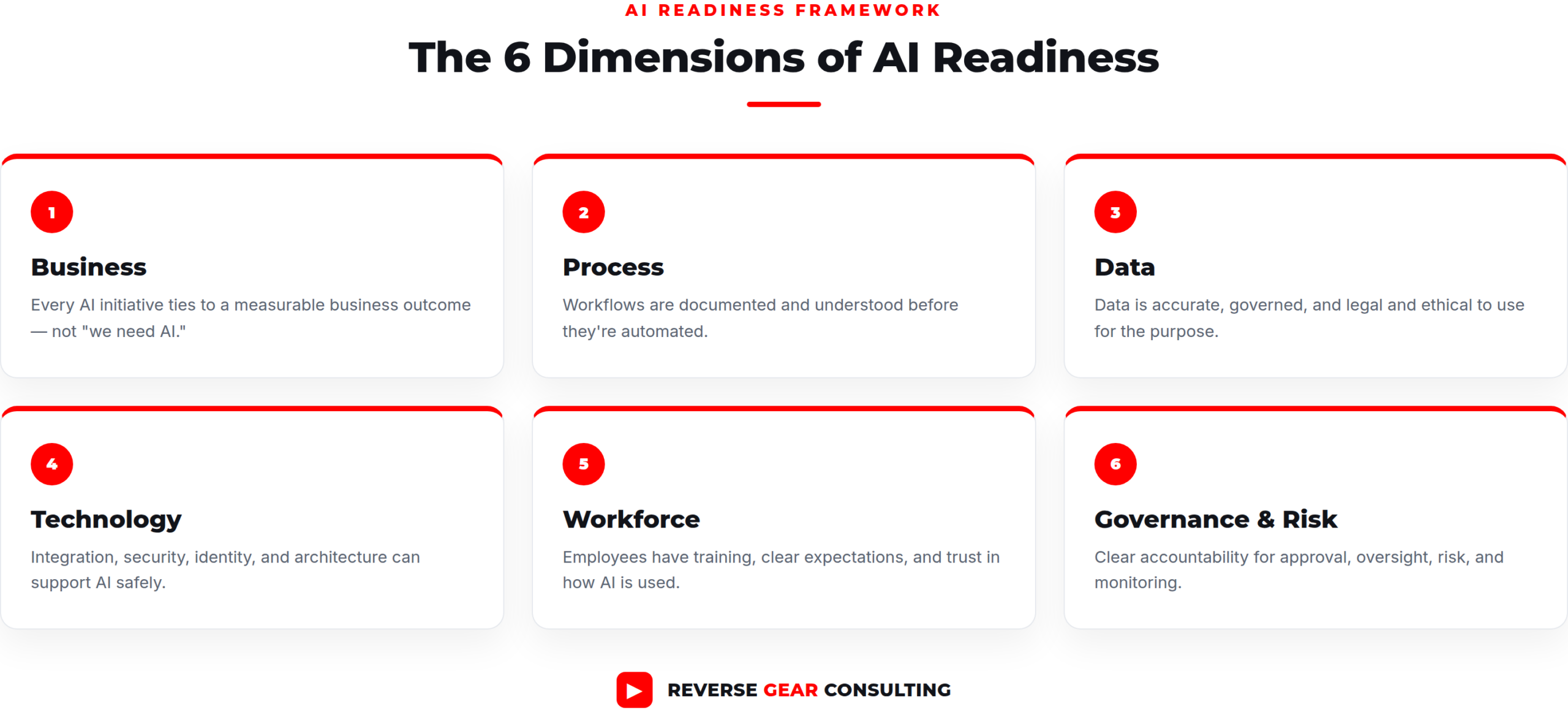
Evaluate readiness before you evaluate platforms. Score your organization across six dimensions — Business, Process, Data, Technology, Workforce, and Governance — then pilot two or three high-value use cases instead of launching ten at once.
AI is a business transformation, not an IT installation
When organizations struggle with technology adoption, the technology gets the blame. In reality, the problem usually started much earlier.
The business problem may never have been clearly defined. Data may be fragmented. Processes may be inconsistent. Employees may not trust the tools. Governance may not exist. Leadership may not be able to describe what success actually looks like.
Introduce AI into that environment and you don't eliminate inefficiency — you automate it. That's why readiness has to come first.
I recommend evaluating AI readiness across six dimensions.
Business Readiness
Start with the business problem. What decision, process, customer experience, or operational challenge are you trying to improve?
Every significant AI initiative should connect to a measurable outcome — reduced processing time, improved quality, increased revenue, better customer experience, or lower operating cost. If the business case begins with "we need AI," you probably need to back up one step.
Process Readiness
AI performs best inside processes that are actually understood. Before you automate a workflow, document it.
Where are the bottlenecks? Where are people doing repetitive work? Where do decisions stall? Which activities add value, and which exist only because "we've always done it that way"? AI should improve a process — not preserve a broken one.
Data Readiness
AI depends heavily on data. You need to know where your data lives, who owns it, whether it's accurate, who can access it, and whether it can be used — legally and ethically — for the intended purpose.
Poor data governance becomes AI risk very quickly.
Technology Readiness
Can your environment securely support AI? That means integration capabilities, APIs, identity management, cybersecurity, infrastructure, data architecture, vendor management, and scalability.
The goal isn't just getting an AI application running. It's integrating AI into the enterprise safely and sustainably.
Workforce Readiness
This is the most underestimated part of AI transformation. Employees need more than access to tools — they need training, clear expectations, acceptable-use guidance, and an understanding of where human judgment still matters.
Leaders also have to address trust. People who believe AI is being introduced mainly to cut jobs will respond very differently from people who understand how it can remove administrative burden and expand what they're capable of.
Governance & Risk Readiness
Who approves AI use cases? Who owns the data? Who evaluates risk? Who validates output? What happens when the technology is wrong?
Governance should cover privacy, cybersecurity, intellectual property, bias, regulatory requirements, third-party technology, human oversight, and ongoing monitoring. Done well, it doesn't prevent innovation — it makes responsible innovation possible.
Start with an AI readiness assessment
Before a major AI investment, score your organization across all six dimensions — Business, Process, Data, Technology, Workforce, Governance — and identify the gaps. You may find you're ready to move immediately in some areas while other use cases need added controls or process redesign first. That's valuable information.
- Select 2–3 high-value use cases that are manageable — not ten at once.
- Establish baseline performance so you can prove the change.
- Pilot the technology in a contained, low-risk way.
- Measure the results against the baseline.
- Capture lessons learned, then scale what works.
This turns AI adoption into a managed transformation — not a technology experiment.
AI with purpose
The objective is never adoption for its own sake — being able to say your organization "uses AI." The objective is business improvement. A successful implementation should eventually produce evidence:
- Faster decisions
- Lower costs
- Better customer experiences
- Improved quality
- Reduced manual effort
- Stronger controls
- Increased capacity
After three decades of organizational and technological change, I've learned that sustainable transformation comes down to the same fundamentals: people, process, technology, governance, and disciplined execution. AI changes what's possible. It doesn't remove the need to execute well.
Ready to assess your AI readiness?
Reverse Gear Consulting helps organizations evaluate AI readiness, identify practical use cases, establish governance, and build implementation roadmaps that connect AI investments to measurable business outcomes.